Section 3 Guided Reading and Review Rights of the Accused
The Rights of the Accused
The rights of the accused include the correct to a fair trial; due process; and the right to privacy.
Learning Objectives
Identify primal showtime-generation homo rights and civil and political rights
Key Takeaways
Central Points
- The rights of the accused are: the correct to a fair trial; due process; to seek redress or a legal remedy; and rights of participation in civil society and politics such equally freedom of association, the correct to assemble, the right to petition, the right of self-defense, and the right to vote.
- Civil and political rights course the original and main part of international human rights. They comprise the showtime portion of the 1948 Universal Declaration of Human Rights (with economic, social and cultural rights comprising the second portion).
- Currently, in many countries with a democratic system and the dominion of police force, criminal procedure puts the burden of proof on the prosecution – that is, it is up to the prosecution to testify that the defendant is guilty across any reasonable uncertainty.
Key Terms
- civil and political rights: Civil and political rights are a class of rights based upon birthright into a polity or designation otherwise of homo rights. They ensure a denizen'south power to fully participate in the ceremonious and political life of the state without discrimination or political repression, and protect the liberty of classes of persons and individuals from unwarranted infringement into those rights by governments, private organizations, and other entities.
- offset-generation rights: First-generation homo rights, often called "blue" rights, bargain essentially with liberty and participation in political life. They are fundamentally civil and political in nature, besides as strongly individualistic: They serve negatively to protect the individual from excesses of the state. Outset-generation rights include, among other things, freedom of speech, the correct to a off-white trial, freedom of organized religion and voting rights. The idea of iii levels of human rights dates to 1979 and is primarily used in European law. This term is rarely, if e'er, used in the U.S.
- criminal process: The legal process for adjudicating claims that someone has violated criminal police force.
Background
The rights of the accused, include the right to a off-white trial; due process; the correct to seek redress or a legal remedy; and rights of participation in civil society and politics such equally liberty of clan, the right to gather, the right to petition, the right of cocky-defense, and the right to vote.
Currently, in many countries with a democratic system and the rule of law, criminal procedure puts the brunt of proof on the prosecution – that is, information technology is up to the prosecution to prove that the defendant is guilty across any reasonable dubiety, as opposed to having the accused prove that s/he is innocent; whatever doubt is resolved in favor of the defendant. Similarly, all such jurisdictions allow the defendant the right to legal counsel and provide any defendant who cannot beget their ain lawyer with a lawyer paid for at the public expense (which is in some countries called a "court-appointed lawyer").
First-generation man rights, frequently called "blue" rights, deal essentially with freedom and participation in political life. They are fundamentally civil and political in nature, besides equally strongly individualistic: They serve negatively to protect the private from the excesses of the state. First-generation rights include, among other things, freedom of spoken communication, the right to a fair trial, freedom of religion and voting rights.
Ceremonious and political rights course the original and principal part of international human rights. They contain the beginning portion of the 1948 Universal Proclamation of Man Rights (with economical, social and cultural rights comprising the 2nd portion). The theory of three generations of human rights considers this group of rights to exist "first-generation rights", and the theory of negative and positive rights considers them to be generally negative rights.
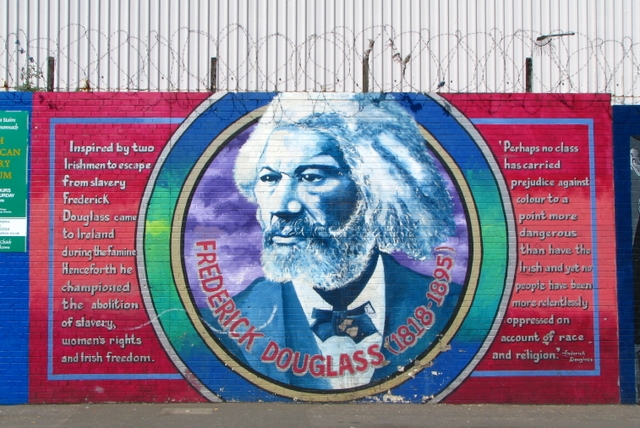
Mural, Falls Road, Belfast.: The mural on the 'International Wall' depicts Frederick Douglass (1815-1895), a former slave who became ane of the foremost leaders of the abolitionist movement which fought to end slavery within the United States in the decades prior to the Civil War. Douglass later served as an adviser to President Abraham Lincoln during the Civil War and fought for the adoption of constitutional amendments that guaranteed voting rights and other civil liberties for blacks. He is however revered today for his contributions against racial injustice.
Civil and political rights are not codification to exist protected, although most democracies worldwide do have formal written guarantees of ceremonious and political rights. Ceremonious rights are considered to be natural rights. Thomas Jefferson wrote in his 1774 A Summary View of the Rights of British America "a complimentary people claim their rights as derived from the laws of nature, and not every bit the gift of their chief magistrate. "
United States Criminal Process
United states criminal procedure derives from several sources of law: the baseline protections of the United States Constitution, federal and state statutes, federal and state rules of criminal procedure (such every bit the Federal Rules of Criminal Procedure), and state and federal example law either interpreting the foregoing or deriving from inherent judicial supervisory authority.
The United States Constitution, including the United states Nib of Rights and subsequent amendments, contains provisions regarding criminal procedure. Due to the incorporation of the Bill of Rights, all of these provisions apply equally to criminal proceedings in country courts, with the exception of the Grand Jury Clause of the Fifth Amendment, the Vicinage Clause of the Sixth Amendment, and (maybe) the Excessive Bond Clause of the Eighth Amendment.
The Fourth Amendment and Search and Seizure
The 4th Amendment to the U.S. Constitution is the part of the Nib of Rights guarding confronting unreasonable searches and seizures.
Learning Objectives
Describe the the historical circumstances that generated the 4th Amendment and the protections the Subpoena affords
Key Takeaways
Primal Points
- The 4th Amendment (Amendment 4) to the U.s. Constitution is the part of the Nib of Rights guarding against unreasonable searches and seizures, as well every bit requiring any warrant to exist judicially sanctioned and supported by likely cause.
- Police officers are not required to advise a doubtable that he/she may reject a search. There are also some circumstances in which a third party who has equal control, or common dominance, over the holding may consent to a search.
- When an individual does non possess a reasonable expectation of privacy that society is willing to admit in a detail piece of property, any interference past the government with regard to that property is not considered a search subject to 4th Subpoena, and a warrant is never required.
Primal Terms
- searches and seizures: A legal procedure used in many civil constabulary and common law legal systems whereby police or other authorities and their agents, who suspect that a offense has been committed, bear a search of a person's property and confiscate whatsoever relevant evidence to the law-breaking.
- Bill of Rights: The commonage proper name for the first x amendments to the The states Constitution.
Background
The Fourth Subpoena (Amendment IV) to the United States Constitution is the part of the Neb of Rights ([fig:9477]]) guarding confronting unreasonable searches and seizures, too as requiring whatever warrant to be judicially sanctioned and supported by probable cause. It was adopted as a response to the corruption of the writ of assistance (a blazon of general search warrant) in the American Revolution. The amendment also states that a search or seizure should be express in scope co-ordinate to specific information supplied by police enforcement to the issuing court. The Fourth Amendment applies to the states by way of the Due Procedure Clause of the Fourteenth Subpoena.
The text of the Fourth Amendment states the post-obit: "The right of the people to be secure in their persons, houses, papers, and furnishings, against unreasonable searches and seizures, shall not be violated, and no Warrants shall issue, but upon probable cause, supported past Oath or affirmation, and especially describing the identify to be searched, and the persons or things to exist seized. "
For example, the owner of the holding in question may consent to the search. The consent must be voluntary, but in that location is no articulate method of determining this; rather, a courtroom volition consider the "totality of the circumstances" in assessing whether consent was voluntary. Police officers are not required to advise a suspect that he/she may reject the search. There are as well some circumstances in which a third party who has equal command, or common authority, over the property may consent to a search.
When an individual does not possess a "reasonable expectation of privacy" that society is willing to acknowledge in a particular piece of property, any interference by the authorities with regard to that holding is not considered a search subject to the Fourth Amendment, and a warrant is never required. For instance, courts have establish that a person does not possess a reasonable expectation of privacy in data transferred to a third party, such as writing on the outside of an envelope sent through the post or left for option-up in an area where others might view it. While that does not hateful that the person has no reasonable expectation of privacy in the contents of that envelope, courts have held that 1 does not possess a reasonable expectation of privacy that society is willing to acknowledge in the contents of garbage left outside the curtilage of a home.

Beak of Rights: 175th ceremony of the Pecker of Rights commemorated on 1966 US postage stamp Plate block of four.
The Fifth Amendment, Self-Incrimination, and Double Jeopardy
The Fifth Subpoena to the U.S. Constitution, which is part of the Bill of Rights, protects against abuse of government authority in a legal procedure.
Learning Objectives
Explain the central provisions of the Fifth Amendment, including cocky-incrimination and double jeopardy.
Key Takeaways
Key Points
- The Fifth Amendment protects witnesses from being forced to incriminate themselves.
- To "plead the 5th" is to refuse to answer a question because the response could provide self-incriminating bear witness of an illegal act punishable past fines, penalties, or forfeiture.
- The Double Jeopardy Clause encompasses iv distinct prohibitions: subsequent prosecution after acquittal, subsequent prosecution subsequently confidence, subsequent prosecution after certain mistrials, and multiple punishments in the same indictment.
Central Terms
- Magna Carta: The 1215 magna carta, also called charter, required King John of England to proclaim certain liberties and accept that his will was not arbitrary. For example, no "freeman" (in the sense of non-serf) could be punished except through the law of the land. This is a right that is withal in existence today.
The Fifth Amendment, Self-Incrimination, and Double Jeopardy
Groundwork on the 5th Amendment
The 5th Amendment (Amendment Five) to the United states Constitution, role of the Bill of Rights, protects against corruption of authorities say-so in a legal process. Its guarantees stem from English common law, which traces dorsum to the Magna Carta in 1215. For example, yard juries and the phrase " due process " (also found in the 14th Subpoena) both trace their origins to the Magna Carta.
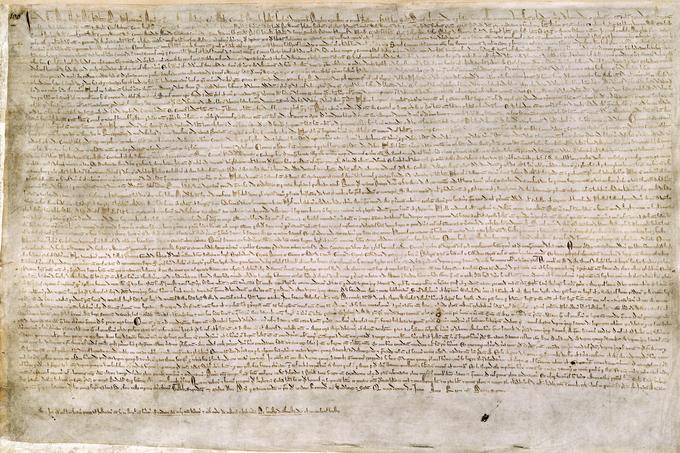
Magna Carta: Magna Carta is ane of the major documents in British history that set forth legal precedents that would later be interpreted every bit protecting the civil rights of English subjects
The text of the Fifth Subpoena reads every bit follows: "No person shall be held to respond for a capital, or otherwise infamous criminal offense, unless on a presentment or indictment of a Grand Jury, except in cases arising in the land or naval forces, or in the Militia, when in actual service in time of War or public danger; nor shall any person be discipline for the aforementioned offense to be twice put in jeopardy of life or limb; nor shall be compelled in whatsoever criminal case to exist a witness against himself, nor exist deprived of life, liberty, or property, without due process of law; nor shall private property exist taken for public use, without only bounty."
Self Incrimination
The Fifth Amendment protects witnesses from existence forced to incriminate themselves. To "plead the Fifth" is to reject to answer a question because the response could provide self-incriminating evidence of an illegal act punishable past fines, penalties, or forfeiture.
Historically, the legal protection against self-incrimination was directly related to the question of torture for extracting information and confessions.
Protection against self-incrimination is implicit in the Miranda rights argument, which protects the "right to remain silent." The Supreme Courtroom has held that "a witness may have a reasonable fear of prosecution and yet be innocent of any wrongdoing. The privilege serves to protect the innocent who otherwise might be ensnared past ambiguous circumstances."
Double Jeopardy
The Double Jeopardy Clause encompasses four distinct prohibitions: subsequent prosecution later amortization, subsequent prosecution subsequently conviction, subsequent prosecution later on sure mistrials, and multiple punishments in the same indictment. Jeopardy "attaches" when the jury is impaneled, the first witness is sworn, or a plea is accustomed.
The government is not permitted to appeal or try again afterward the entry of an acquittal. The prohibition extends to a directed verdict before the case is submitted to the jury, a directed verdict after a deadlocked jury, an appellate reversal for sufficiency (except past direct entreatment to a higher appellate court), and an "implied acquittal" via conviction of a bottom included offense.
Blockburger 5. U.s. addresses multiple punishments, including prosecution after conviction. In Blockburger v. United States (1932), the Supreme Court appear the following test: the government may separately try and punish the defendant for two crimes if each law-breaking contains an element that the other does not. Blockburger is the default dominion, unless the legislature intends to depart from it via enacted law; for example, Continuing Criminal Enterprise (CCE) may be punished separately from its predicates, as can conspiracy.
The dominion for prosecution after mistrials depends on who sought the mistrial. If the defendant moved for a mistrial, there is no bar to retrial, unless the prosecutor acted in bad organized religion. For example, the prosecutor goads the defendant into moving for a mistrial because the government specifically wanted a mistrial. If the prosecutor moves for a mistrial, there is no bar to retrial if the trial judge finds "manifest necessity" for granting the mistrial. The same standard governs mistrials granted sua sponte.
The Exclusionary Rule
The exclusionary rule holds that evidence collected in violation of the accused'due south rights is sometimes inadmissible.
Learning Objectives
Describe the ramble bases of the exclusionary rule
Central Takeaways
Primal Points
- The exclusionary rule is grounded in the 4th Amendment and is intended to protect citizens from illegal searches and seizures.
- The exclusionary dominion is designed to provide disincentive to prosecutors and police who illegally assemble show in violation of the Fifth Amendment of the Beak of Rights.
- The exclusionary dominion is not applicable to aliens residing exterior of U.South. borders. In U.s. v. Alvarez-Machain, 504 U.Southward. 655, the U.S. Supreme Court decided that belongings owned by aliens in a foreign country is admissible in courtroom.
Key Terms
- constitutional right: Rights given to citizens by the constitution.
- right to counsel: When a citizen accused has the right to be legally represented by a legal defense.
- exclusionary rule: A legal principle in the United States, nether constitutional law, which holds that testify collected or analyzed in violation of the defendant's constitutional rights is sometimes inadmissible for a criminal prosecution in a courtroom of law.
Groundwork
The exclusionary rule is a legal principle in the United states holding that evidence collected or analyzed in violation of the defendant 'southward constitutional rights is sometimes inadmissible for criminal prosecution. This may exist considered an example of a safe dominion formulated by the judiciary in lodge to protect a constitutional correct. However, in some circumstances, the exclusionary rule may also exist considered to follow direct from the constitutional language. For example, the Fifth Amendment's control that no person "shall be deprived of life, liberty or holding without due procedure of law. "
The exclusionary rule is grounded in the Fourth Amendment and is intended to protect citizens from illegal searches and seizures. The exclusionary rule is besides designed to provide disincentive to prosecutors and police who illegally gather evidence in violation of the Fifth Amendment of the Bill of Rights. The exclusionary rule furthermore applies to violations of the Sixth Amendment, which guarantees the right to counsel.
Most states take their own exclusionary remedies for illegally obtained evidence under their state constitutions and/or statutes. This rule is occasionally referred to as a legal technicality because it allows defendants a defense that does non address whether the crime was really committed. In this respect, information technology is similar to the explicit rule in the 5th Subpoena protecting people from double jeopardy. In strict cases, when an illegal action is used by police/prosecution to gain any incriminating consequence, all bear witness whose recovery stemmed from the illegal activeness can exist thrown out from a jury.
The exclusionary rule applies to all persons within the Us regardless of whether they are citizens, immigrants (legal or illegal), or visitors.
Limitations of the Rule
The exclusionary rule was passed in 1917, and does not apply in a civil case, a grand jury proceeding, or a parole revocation hearing.
Even in a criminal case, the exclusionary rule does not simply bar the introduction of all evidence obtained in violation of the Fourth, Fifth, or 6th Amendments.
The exclusionary dominion is non applicable to aliens residing outside of U.Due south. borders. In United states of america v. Alvarez-Machain, 504 U.S. 655, the Supreme Court decided that belongings owned by aliens in a foreign state is open-door in courtroom. Prisoners, probationers, parolees and persons crossing U.S. borders are among those receiving limited protections. Corporations, by virtue of existence, likewise have express rights nether the 4th Amendment (see corporate personhood).
Criticism of the Rule
The exclusionary rule as it has adult in the U.Due south. has been long criticized, even by respected jurists and commentators. Judge Benjamin Cardozo, generally considered ane of the most influential American jurists, was strongly opposed to the rule, stating that under the dominion, "The criminal is to get free because the constable has blundered. "

U.Southward. Supreme Court Seal: The Supreme Court of the United States is the highest court in the country. It has ultimate (but largely discretionary) appellate jurisdiction over all federal courts and over state court cases involving issues of federal law, and original jurisdiction over a small range of cases.
The Sixth Subpoena and the Right to Counsel
The Assistance of Counsel Clause in the Sixth Amendment allows to any person accused the right to counsel for his defense.
Learning Objectives
Summarize the protections afforded an accused nether the Sixth Subpoena's Assist of Counsel Clause
Cardinal Takeaways
Key Points
- The assistance of counsel clause includes, as relevant here, v distinct rights: the correct to counsel of choice, the right to appointed counsel, the correct to conflict-costless counsel, the constructive aid of counsel, and the correct to represent oneself, in legal terms known every bit pro se.
- Criminal defendants have a right to exist represented by counsel of their choice. The remedy for erroneous depravation of first pick counsel is automatic reversal.
- Every bit stated in Brewer v. Williams, 1977, the right to counsel means at to the lowest degree that a person is entitled to the aid of a lawyer at or after the time that judicial proceedings have been initiated against him, whether by formal charge, preliminary hearing, indictment, information, or accusation.
- The pivotal case that established the right to counsel in State courts was Gideon 5. Wainwright in 1963. Clarence Earl Gideon was convicted of breaking and entering and was imprisoned. He sent a paw-written entreatment to the Supreme Court claiming a correct to have counsel provided for him as he could not afford an attorney. The court, in a 9-0 decision, applied the Bill of Rights to usa and determined that indigent defendants are entitled to legal defense at public expense.
Central Terms
- jury proceedings: The The states is the only common police force jurisdiction in the world that continues to use the grand jury to screen criminal indictments.
- right to counsel: When a citizen accused has the right to be legally represented by a legal defence force.
Background
The Assist of Counsel Clause of the Sixth Amendment to the United States Constitution provides: "In all criminal prosecutions, the accused shall savor the correct… to take the Assistance of Counsel for his defense."
The assistance of counsel clause includes, as relevant here, five distinct rights:
- The right to counsel of choice
- The right to appointed counsel
- The right to conflict-costless counsel
- The constructive help of counsel
- The right to correspond oneself pro se
As stated in Brewer v. Williams, 430 U.S. 387 (1977), the right to counsel ways "at least that a person is entitled to the assistance of a lawyer at or afterward the time that judicial proceedings have been initiated against him, whether by formal charge, preliminary hearing, indictment, information, or accusation." Brewer goes on to conclude that in one case adversarial proceedings have begun against a defendant, he has a right to legal representation when the authorities interrogates him and that when a defendant is arrested, "arraigned on an arrest warrant before a judge" and "committed by the court to confinement… there can be no doubt that judicial proceedings have been initiated."
Individuals subject to k jury proceedings practise not have a Sixth Amendment right to counsel because grand juries are not considered by the U.S. Supreme Court to be criminal proceedings, which trigger the protections of that constitutional protection.
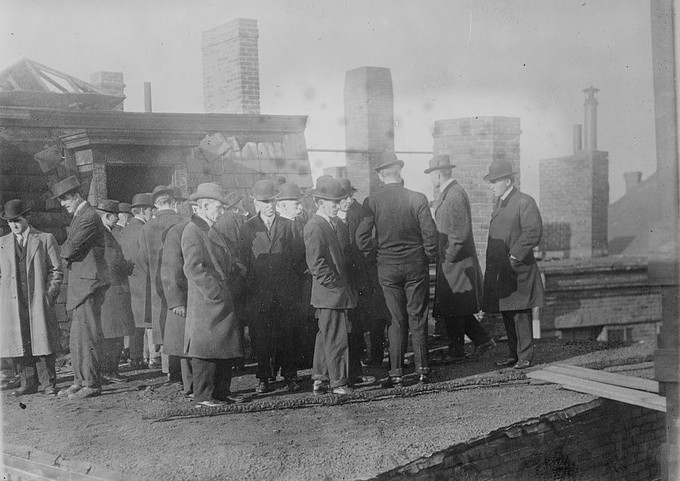
Grand Jury at Arcadia Hotel Burn down.: A grand jury investigating the fire that destroyed the Arcadia Hotel in Boston, Massachusetts in 1913.
In the 2009-2010 term of the United States Supreme Court, it was handed downward that a suspect'south request for legal counsel is simply skilful for fourteen days subsequently the suspect is released from police force custody.
Choice of Counsel
Subject area to considerations such every bit conflicts of interest, scheduling, counsel's potency to practice law in the jurisdiction, and counsel's willingness to represent the defendant (whether pro bono or for a fee), criminal defendants have a right to be represented by counsel of their selection. The remedy for erroneous depravation of first pick counsel is automated reversal.
Whether counsel is retained or appointed, the defendant has a right to counsel without a conflict of involvement. If an actual conflict of involvement is present, and that conflict results in whatever agin effect on the representation, the event is automatic reversal. The full general rule is that conflicts can exist knowingly and intelligently waived, but some conflicts are non-waiveable.
Appointment of Counsel
In Powell five. Alabama, 287 U.S. 45 (1932), the Supreme Court ruled that "in a capital case, where the defendant is unable to use counsel, and is incapable of fairly making his own defense considering of ignorance, feeble mindedness, illiteracy, or the like, information technology is the duty of the courtroom, whether requested or non, to assign counsel for him." In Johnson five. Zerbst, 304 U.S. 458 (1938), the Supreme Court ruled that in all federal cases, counsel would take to be appointed for defendants who were besides poor to hire their own. All the same, in Betts 5. Brady, 316 U.S. 455 (1942), the Court declined to extend this requirement to the land courts under the Fourteenth Subpoena unless the defendant demonstrated "special circumstances" requiring the assistance of counsel.
Ineffective Assistance of Counsel
In Strickland 5. Washington (1984), the Court held that, on collateral review, a defendant may obtain relief if the defendant demonstrates both that the defense counsel'south functioning fell below an objective standard of reasonableness (the "performance prong") and that, but for the scarce performance, there is a reasonable probability that the result of the proceeding would have been dissimilar (the "prejudice prong").
To satisfy the prejudice prong of Strickland, a accused who pleads guilty must bear witness that, just for counsel's deficient operation, he or she would non accept plead guilty.
Pro Se Legal Representation in the United states of america
A criminal defendant may represent himself, unless a court deems the accused to be incompetent to waive the correct to counsel.
In Faretta v. California, 422 U.S. 806 (1975), the Supreme Court recognized the defendant's right to pro se representation. However, under Godinez v. Moran, 509 U.S. 389 (1993), a court can crave a defendant to be represented by counsel if it believes the defendant less than fully competent to fairly go on without counsel.
Some states extend the correct to counsel to all matters where a defendant's liberty interest is threatened. The New Jersey Supreme Court unanimously held that, regardless of whether the proceeding is labeled as civil, criminal, or administrative, if a defendant faces a loss of liberty, she or he is entitled to appointed counsel if indigent. Anne Pasqua, et al. v. Hon. Gerald J. Council, et al., 186 Northward.J. 127 (2006) (March 2006).
The 6th Amendment and Jury Trials
The 6th Subpoena U.Due south. Constitution is the part of the Pecker of Rights, which sets forth rights related to criminal prosecutions.
Learning Objectives
Summarize the rights afforded to an accused under the Sixth Subpoena and describe the protocols in place to achieve the impartiality of the jury to ensure these rights
Key Takeaways
Fundamental Points
- The Sixth Amendment (Subpoena Six) to the U.S. Constitution is the function of the Beak of Rights, which sets forth rights related to criminal prosecutions. The Supreme Courtroom has practical the protections of this amendment to the states through the Due Process Clause of the Fourteenth Amendment.
- The right to a jury has always depended on the nature of the offense with which the accused is charged.
- The Sixth Amendment requires juries to be impartial. Impartiality has been interpreted every bit requiring private jurors to be unbiased.
- The jury panel must represent a fair cantankerous-section of the community.
Key Terms
- voir dire: The preliminary phase of a jury trial in which the jurors are examined and selected.
- impartiality: The quality of being impartial; fairness.
- petty offenses: Criminal offenses punishable by imprisonment for not more than than 6 months and are non covered by the jury requirement.
Background
The Sixth Subpoena (Amendment Half dozen) to the United States Constitution is the part of the United states of america Pecker of Rights, which sets along rights related to criminal prosecutions. The Supreme Court has applied the protections of this subpoena to the states through the Due Process Clause of the Fourteenth Amendment.
The Sixth Amendment states the post-obit: "In all criminal prosecutions, the accused shall enjoy the right to a speedy and public trial, by an impartial jury of the State and commune wherein the offense shall have been committed, which district shall take been previously ascertained by police force, and to be informed of the nature and cause of the accusation; to be confronted with the witnesses confronting him; to have compulsory procedure for obtaining witnesses in his favor, and to accept the Assistance of Counsel for his defense."
Impartial Jury
The right to a jury has always depended on the nature of the offense with which the defendant is charged. Piddling offenses are those punishable by imprisonment for not more than six months and are not covered by the jury requirement. Even where multiple petty offenses are concerned, the full time of imprisonment possibly exceeding 6 months, the right to a jury trial does not be. As well, in the United States, except for serious offenses (such every bit murder), minors are usually tried in a juvenile court, which lessens the sentence allowed, only forfeits the right to a jury.
Originally, the Supreme Court held that the Sixth Amendment right to a jury trial indicated a right to "a trial by jury as understood and practical at mutual police, and includes all the essential elements as they were recognized in this country and England when the Constitution was adopted." Therefore, it was held that juries had to be equanimous of twelve persons and that verdicts had to be unanimous, as was customary in England.
When, under the Fourteenth Amendment, the Supreme Court extended the right to a trial by jury to defendants in country courts, it re-examined some of the standards. It has been held that twelve came to be the number of jurors by "historical blow," and that a jury of vi would be sufficient, but anything less would deprive the accused of a correct to trial by jury. Although on the basis of history and precedent the Sixth Amendment mandates unanimity in a federal jury trial, the Supreme Court has ruled that the Due Process Clause of the Fourteenth Amendment, while requiring States to provide jury trials for serious crimes, does non comprise all the elements of a jury trial within the meaning of the 6th Subpoena and does not require jury unanimity.
Impartiality
The Sixth Subpoena requires juries to be impartial. Impartiality has been interpreted as requiring individual jurors to be unbiased. At voir dire, each side may question potential jurors to determine whatsoever bias, and challenge them if the same is found; the courtroom determines the validity of these challenges for cause. Defendants may not claiming a confidence on the ground that a challenge for cause was denied incorrectly if they had the opportunity to use peremptory challenges.
Another gene in determining the impartiality of the jury is the nature of the panel from which the jurors are selected. The jury panel must represent a fair cross-section of the community; the defendant may establish that the requirement was violated by showing that the allegedly excluded grouping is a "distinctive" one in the community, that the representation of such a group in venires is unreasonable and unfair in regard to the number of persons belonging to such a grouping, and that the nether-representation is acquired past a systematic exclusion in the selection process. Thus, in Taylor 5. Louisiana, 419 U.S. 522 (1975), the Supreme Court invalidated a state law that exempted women who had non made a declaration of willingness to serve from jury service, while non doing the aforementioned for men.

The Jury Panel: Great Lakes, Ill. (Dec. 23, 2008) Legalman 1st Class Christie Richardson, a trial services legalman assigned to Region Legal Service Function Midwest makes an opening statement for the prosecution to a jury during a mock trial. Richardson was part of a legal team demonstrating the legal system for 22 Navy Junior Reserve Officers Preparation Corps (NJROTC) cadets from Chicago-surface area high schools.
The Eighth Amendment and Roughshod and Unusual Punishment
The Eight Amendment determines the provisions for barbarous and unusual punishment.
Learning Objectives
Summarize the sources of the Eight Amendment in British history and significance moments in American example police
Central Takeaways
Primal Points
- The 8th Amendment of the Usa Constitution prohibits the federal government from imposing excessive bond, excessive fines or cruel and unusual penalty.
- The Virginia Declaration of Rights of 1776 had already adopted the English Bill of Rights ' stance on barbarous and unusual penalization The state later recommended that this linguistic communication also exist included in the Constitution.
- Justice Brennan wrote that no country would violate any one of the four principles prohibiting cruel and unusual punishment. Court decisions regarding the Eighth Amendment would involve a "cumulative" analysis of the implication of each of the four principles.
Primal Terms
- cadena temporal: A onetime form of punishment overturned by the Supreme Courtroom. It mandated "hard and painful labor," shackling for the duration of incarceration, and permanent civil disabilities.
Background
The Eighth Amendment of the The states Constitution prohibits the federal authorities from imposing excessive bail, excessive fines or cruel and unusual punishments. The U.Southward. Supreme Courtroom has ruled that this subpoena'due south Barbarous and Unusual Punishment clause applies to states. The phrases employed originated in the English Pecker of Rights of 1689.
The Eighth Amendment was adopted as part of the Bill of Rights in 1791. The provision was largely inspired by the case of Titus Oates. The Englishman was tried in 1685 for multiple acts of perjury during the ascension of King James Ii after a number of people whom Oates had wrongly accused of treason were executed. Oates was sentenced to imprisonment, forth with an annual ordeal of whipping and time in the pillory. The Oates case became a topic of the U.Southward. Supreme Court's Eighth Amendment jurisprudence. Oates'south punishment involved ordinary penalties collectively imposed in an excessive and unprecedented way. The reason Oates did non receive the death penalty may be considering the penalty would have deterred even honest witnesses from testifying in afterwards cases.
The Virginia Declaration of Rights of 1776 had already adopted the English language Pecker of Rights' opinion on fell and unusual penalization The country later recommended that this language also be included in the Constitution.
According to the Supreme Court, the Eighth Amendment forbids some punishments entirely, prohibiting other punishments that are deemed excessive when compared to the law-breaking or the competence of the perpetrator.
Punishments Forbidden for Sure Crimes

Punishment of the Paddle: This is an quondam course of punishment.
The case of Weems v. United States, (1910) marked the first time that the Supreme Court exercised judicial review to overturn a criminal sentence every bit vicious and unusual. The Court overturned a punishment called cadena temporal, which mandated "difficult and painful labor," shackling for the duration of incarceration and permanent civil disabilities. This case is oftentimes viewed as establishing a principle of proportionality under the Eighth Amendment. Even so, others have written "it is hard to view Weems as announcing a constitutional requirement of proportionality. "
In Trop v. Dulles, (1958), the Supreme Courtroom held that taking away citizenship from a natural-born citizen for a crime was unconstitutional. The punishment was considered "more archaic than torture" because it involved the "total devastation of the individual's condition in organized order. "
In Furman v. Georgia (1972), Justice Brennan wrote that there are four principles by which particular punishment is deemed cruel and unusual: Punishment should not be apparently unnecessary, degrading to human dignity, inflicted in a wholly arbitrary fashion, or severe enough to be clearly rejected throughout guild.
It is up to individual states to decide if death tin be considered "cruel and unusual" penalty. As of 2016, 31 states (and the federal authorities) had expiry every bit an acceptable form of penalization. Justice Brennan as well wrote that no state would pass a constabulary violating any i of these principles. Court decisions regarding the 8th Amendment would hence involve a "cumulative" analysis of the implication of each of the four principles, setting a standard in the manner punishments were considered brutal and unusual.
In California, more than than 700 inmates await execution, with the last execution occurring in 2006. Because California's death penalty was approved by voter initiative, it can only exist repealed by voters and non the legislature. Prop. 62 on the Nov. 8, 2016 ballot will ask voters to exercise repeal its death punishment.
The Miranda Warning
The Miranda warning is a statement read by law to criminal suspects that asserts their right to counsel and correct to remain silent.
Learning Objectives
Describe the Miranda Rights and the obligations they impose on police force
Key Takeaways
Fundamental Points
- The Miranda warning (also referred to as Miranda rights) is a alarm given past law in the United States to criminal suspects in police custody.
- The Miranda rule applies to the apply of testimonial evidence in criminal proceedings that is the production of custodial police interrogation. Miranda right to counsel and right to remain silent are derived from the self-incrimination clause of the Fifth Amendment.
- The Miranda dominion would apply unless the prosecution can establish that the argument falls inside an exception to the Miranda rule. The three exceptions are (1) the routine booking question exception (ii) the jailhouse informant exception and (3) the public safety exception.
Central Terms
- process rule: It is the body of police force that sets out the rules and standards that courts follow when adjudicating civil lawsuits (equally opposed to procedures in criminal law matters).
- testimonial evidence: It is the proof given past the product of custodial police interrogation.
Background
The Miranda alert (also referred to every bit Miranda rights) is a alarm given by police in the United States to criminal suspects in police custody (or in a custodial interrogation) before they are interrogated to preserve the admissibility of their statements confronting them in criminal proceedings.

Incorporating Amendment Five: Here, a US law enforcement official reads an arrested person his rights. Amendment V, the correct to due procedure, has been incorporated against the states.
In other words, a Miranda warning is a preventive criminal procedure dominion that law enforcement is required to administrate to protect an individual who is in custody and subject to direct questioning or its functional equivalent from a violation of his or her Fifth Subpoena right against compelled cocky-incrimination. In Miranda v. Arizona, the Supreme Courtroom held that the access of an elicited incriminating argument by a suspect not informed of these rights violates the Fifth and the 6th Amendment correct to counsel.
Mirada refers to Ernesto Miranda. In 1963 Miranda was arrested in Phoenix and charged with rape, kidnapping, and robbery. Miranda was not informed of his rights prior to the police interrogation. During the two-hour interrogation, Miranda allegedly confessed to committing the crimes, which the police plain recorded. Miranda, who had not finished ninth course and had a history of mental instability, had no counsel present. At trial, the prosecution'south case consisted solely of his confession. Miranda was convicted of both rape and kidnapping and sentenced to twenty to 30 years in prison. Miranda appealed to the U.S. Supreme Court and won his example. The Supreme Courtroom devised a statement that must exist read to those who are arrested.
Thus in theory, if law enforcement officials reject to offering a Miranda alert to an private in their custody, they may still interrogate that person and deed upon the knowledge gained, just may not use that person'due south statements to incriminate him or her in a criminal trial. Nevertheless, in the businesslike interactions between police force and citizens, this is rarely true. In Berghuis v. Thompkins, the court held that unless a suspect really states that he is relying on this right, his subsequent voluntary statements can be used in courtroom and police tin can continue to interact with or question him.
The Miranda rule applies to the use of testimonial evidence in criminal proceedings that is the product of custodial police interrogation. The Miranda right to counsel and right to remain silent are derived from the cocky-incrimination clause of the 5th Amendment.
It is important to notation that immigrants who alive in the United states illegally are as well protected and should receive their Miranda warnings besides when being interrogated or placed under arrest. Aliens receive constitutional protections when they have come within the territory of the United States and have developed substantial connections with this country.
Exclamation of Miranda Rights
If the defendant asserts his right to remain silent all interrogation must immediately stop and the police may not resume the interrogation unless the constabulary accept "scrupulously honored" the defendant's assertion and obtain a valid waiver earlier resuming the interrogation. In determining whether the police "scrupulously honored" the assertion the courts apply a totality of the circumstances test. The most important factors are the length of time between the termination of the original interrogation and start of the 2d and a fresh set of Miranda warnings earlier resumption of interrogation.
The consequences of assertion of Fifth Subpoena right to counsel are stricter. The police force must immediately end all interrogation and the police cannot reinitiate interrogation unless counsel is nowadays (just consulting with counsel is insufficient) or the defendant contacts the police force on his own volition. If the defendant does reinitiate contact, a valid waiver must exist obtained before interrogation may resume.
In Berghuis v. Thompkins, the Court ruled that a suspect must clearly and unambiguously assert right to silence. Merely remaining silent in face of protracted questioning is insufficient to assert the right.
Exceptions of Miranda Rights
The Miranda rule would utilise unless the prosecution can institute that the argument falls inside an exception to the Miranda rule. The three exceptions are (ane) the routine booking question exception (2) the jailhouse informant exception and (3) the public safety exception. Arguably only the concluding is a truthful exception–the first two tin can better exist viewed as consistent with the Miranda factors. For instance, questions that are routinely asked as part of the administrative process of abort and custodial commitment are not considered "interrogation" under Miranda because they are not intended or likely to produce incriminating responses. Nonetheless, all three circumstances are treated as exceptions to the rule.
Section 3 Guided Reading and Review Rights of the Accused
Source: https://courses.lumenlearning.com/boundless-politicalscience/chapter/the-rights-of-the-accused/
0 Response to "Section 3 Guided Reading and Review Rights of the Accused"
Post a Comment